When most or all of the teeth in one jaw are missing or failing, patients usually come to us with one question: should I get dentures or implants? Both can give you a full set of teeth again. But they are very different in how they feel, how you look after them and what they cost over the years. This is the comparison we walk through with patients at a first consultation.
What each option actually is
A complete denture is a removable plate of acrylic teeth that rests on the gums. An upper denture is held mainly by suction against the palate. A lower denture sits on a narrow ridge of gum and bone and relies largely on the tongue and cheeks to stay in place, which is why lower dentures are the ones people struggle with most.
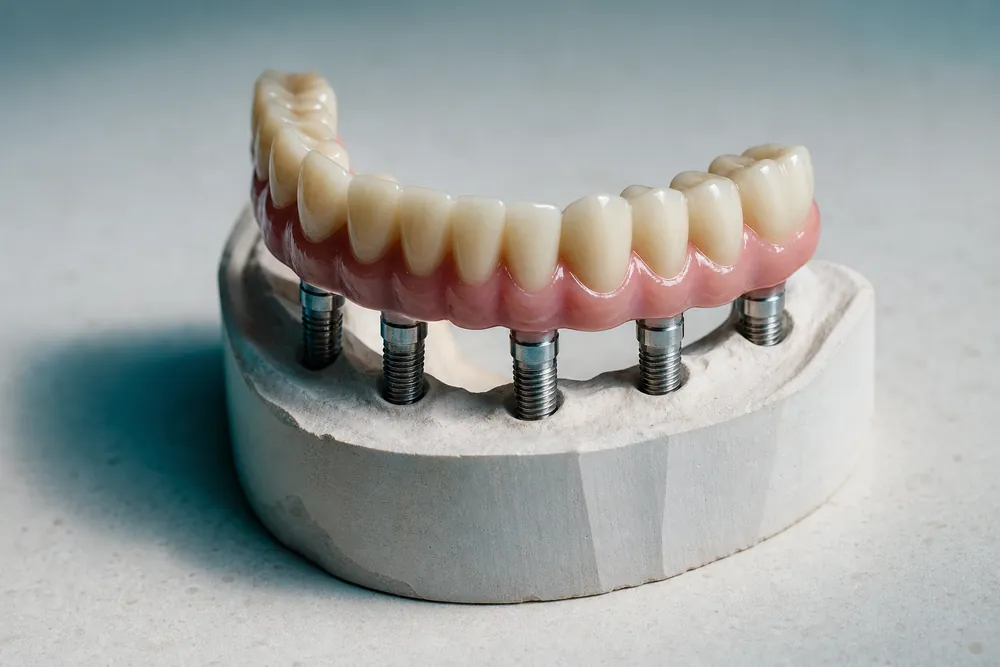
All-on-6 is a fixed bridge of 12 to 14 teeth secured onto six implants placed in the jaw. You cannot take it out at home; only your dentist removes it for professional cleaning and checks. Using six implants rather than four spreads the biting forces more widely and, in many cases, gives an extra margin of support if one implant ever develops a problem.
Eating, speaking and confidence
This is where the difference is most obvious. Many denture wearers avoid steak, nuts, apples or crusty bread, and some use adhesive every day to stop the lower denture moving when they talk. Chewing efficiency with a complete denture is only a fraction of what natural teeth achieve, so meals can take longer and some foods are simply off the menu.
An All-on-6 bridge is fixed, so it does not move when you speak, laugh or eat. Because the upper bridge does not need to cover the palate, food tastes and temperatures feel more natural. Most patients adapt to their new teeth within a few weeks and return to a near-normal diet once the implants have fully healed.
What happens to the jawbone
When teeth are lost, the bone that held them slowly shrinks because it is no longer stimulated by chewing. A denture does not stop this. Over the years the ridge becomes flatter, the denture loosens and needs relining or remaking, and the lower third of the face can lose height, which makes the face look older.
Implants pass chewing forces into the bone, which helps to preserve it around them. With 3D planning, implants can often be angled to make the most of the bone that is available, so some patients who were told they would need extensive bone grafting can still be treated with All-on-6. At our JLT clinic, Dr. James Whitfield places implants in a 3D guided implant surgery suite, and our in-house dental lab makes the bridge.
Treatment time and what to expect
A new set of dentures usually takes a few weeks and several fitting appointments. All-on-6 typically follows this path:
- A consultation with a 3D scan, followed by a written treatment plan and quote
- Any remaining extractions and the placement of all six implants in one surgery, under local anaesthetic or conscious sedation at JLT
- A fixed temporary bridge, often within a few days of surgery
- The final bridge once the implants have healed, usually three to six months later
Not everyone can have fixed teeth so soon after surgery. It depends on how firmly the implants are anchored in the bone, and your surgeon will confirm this on the day.
The real cost over time
Dentures cost less at the start, and for some people they are the right choice, for example when surgery is not advisable for medical reasons. But they usually need relining every couple of years and replacing every five to eight years, and adhesives, repairs and soreness add up.
At Veloradent, All-on-6 starts from AED 39,000 per arch, and your written plan sets out exactly what is included. If you only need a few teeth replaced, single implants start from AED 4,500, or from AED 6,900 with the crown. You can spread the cost with 0% instalments over 3, 6 or 12 months on selected bank credit cards, or with Tabby or Tamara. If you already have a plan from another clinic, bring it with your recent X-rays for a free second opinion.
Which is right for you?
All-on-6 tends to suit people who are tired of a loose denture, whose remaining teeth are failing and who are healthy enough for minor oral surgery. Uncontrolled diabetes and heavy smoking raise the risk of implant problems, so we discuss these openly. A denture may be the better option if surgery is not suitable, or as a temporary solution while you decide. Dr. Layla Haddad and Dr. James Whitfield plan full-arch cases together, so you hear both the restorative and the surgical view before you make up your mind.
This article is general information and does not replace an examination. Your dentist will confirm what suits you.