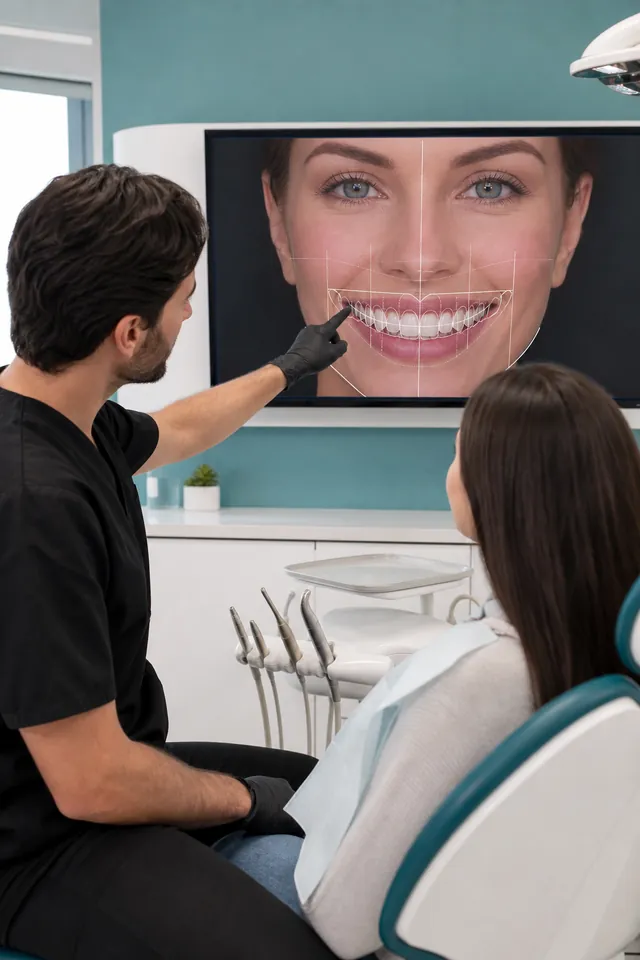
Digital Smile Design (DSD) is a planning process, not a treatment in itself. We start with high-quality photos of your face and teeth, a short video of you talking and smiling, and an intraoral scan that records your teeth in 3D. The video matters because a smile moves: it shows how much tooth you show at rest, when you speak and when you laugh. Your dentist uses these records to plan tooth length, width and shape in proportion with your lips, face and gum line.
The design is built in 3D software on your scan, so every proportion has a real measurement behind it. From that digital plan, our in-house lab at JLT prepares a model and a template for your mock-up: a thin layer of tooth-coloured resin that sits over your own teeth. You wear it in the clinic, see it in the mirror and on camera, and tell us what to change. Nothing is drilled until you have approved the shape.
DSD helps when you are considering veneers, crowns, bonding or a combination, and when you want to understand the result before you commit. It also helps your dentist choose the least invasive route. Sometimes the design shows that aligners, whitening or a little bonding will reach the goal without porcelain. The design fee is AED 950, and it is credited towards your treatment if you go ahead. You then decide, with a clear plan and cost in front of you.
Benefits
See it before it happens
A resin mock-up of the design sits over your own teeth, so you can judge the new smile in the mirror, in photos and in conversation before any treatment.
Planned around your face
Photos and video show how your lips, gum line and facial features move. The design follows those proportions rather than a standard template used for everyone.
Measured, not guessed
An intraoral scan gives accurate 3D data, so tooth length and width are planned to fractions of a millimetre and passed straight to our in-house lab.
The least invasive route
Seeing the target first helps us remove only what the design requires. Sometimes it shows that whitening, bonding or aligners are enough without any porcelain.
How treatment works
Consultation and records
Your dentist examines your teeth and gums and asks what you would like to change. We take facial and dental photos, a short video and an intraoral 3D scan.
3D design
Your dentist designs the new tooth shapes on the scan and checks them against your photos and video. You see the proposed smile on screen and can comment before anything is made.
Mock-up try-in
Our JLT lab turns the design into a template. At your second visit, resin is placed over your teeth to show the new smile. It comes off easily afterwards, with no drilling.
Treatment plan
Once you approve the shape, you receive a written plan with options, timings and costs. If you proceed, the AED 950 design fee is credited towards your treatment.
Is it right for you?
- Patients considering veneers, crowns or bonding on several front teeth
- Anyone who wants to see and approve the final shape before committing
- People unhappy with tooth proportions, a gummy smile or an uneven smile line
- Patients combining orthodontics with cosmetic work who need one coordinated plan
Your dentists for digital smile design


Frequently asked questions
How much does Digital Smile Design cost?
Digital Smile Design at Veloradent starts from AED 950. This covers the photos, video, intraoral scan, 3D design and the mock-up try-in. If you go ahead with treatment, the fee is credited towards it. Treatment itself can be spread over 3, 6 or 12 months at 0% on selected bank credit cards, or split with Tabby or Tamara.
Is the mock-up the same as my final result?
The mock-up shows the planned shape, length and proportions very closely, but it is made from temporary resin, so it looks slightly less glossy and natural than porcelain. Think of it as a three-dimensional sketch. If you like the shape, the final veneers or crowns are made to match it, with colour and surface detail refined by our ceramist.
Does the try-in involve any drilling?
No. The mock-up is placed over your natural teeth without any preparation and is removed at the end of the appointment. It does not damage the enamel. Drilling, if it is needed at all, only happens later, during treatment you have already approved, and the mock-up then guides how little tooth needs to be removed.
Do I have to go ahead with treatment after the design?
No. Many patients use the design to decide calmly, compare options or plan treatment in stages. You leave with a clear understanding of what is possible for your teeth and what each option involves. Take your time and ask about anything that is not clear. The fee is only credited towards treatment if you decide to go ahead.
Which treatments can be planned with DSD?
Mostly veneers, crowns and composite bonding on the front teeth, but also combined plans. For example, a short course of Invisalign before veneers can mean less preparation later. DSD is also useful when an implant crown needs to blend in with natural teeth or veneers nearby. Your dentist will explain which approach suits your case.